
DATA CENTERS The Compute Continent
Jote Antonale
4/27/20265 min read
DATA CENTERS
The Compute
Continent
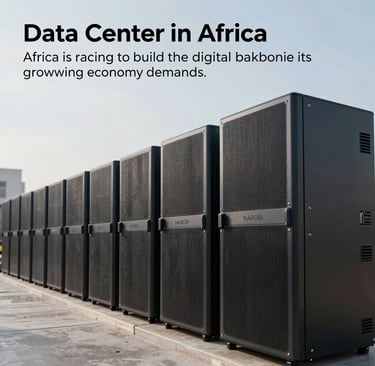
Africa is racing to build the digital backbone its growing economy demands. From Casablanca to Lagos to Nairobi, a new generation of hyperscale facilities is rewriting the continent's infrastructure story — and the stakes have never been higher.
$2.22BMarket size in 2026 $4.36BProjected by 2031 223Data centers across 38 countries,700+New facilities needed to meet demand
In April 2026, two announcements landed within weeks of each other that would have seemed implausible just three years ago. A 100 MW AI-capable hyperscale data center began commercial operations in Nigeria's Lekki corridor. In Casablanca, Morocco secured a $1.2 billion AI data center project — led by an international consortium including Nvidia — set to scale from 40 MW to 500 MW and serve sovereign computing needs across Africa, Europe, and the Middle East. At roughly the same time, Equinix committed approximately $438 million to expand its South African footprint by an additional 160 MW. These are not incremental additions. They are signals that Africa's digital infrastructure is entering a phase of structural transformation.
For much of the past decade, African data center development lagged well behind the pace of the continent's digital adoption. Mobile money flourished, e-commerce exploded, and fintech startups scaled — yet the physical infrastructure underpinning these services remained largely hosted overseas, with African data routed through hubs in Europe before coming back to local users. That arrangement made economic and practical sense when local alternatives were scarce. It makes far less sense today, and a combination of regulatory pressure, AI-driven demand, and fresh capital is driving a decisive course correction.
The scale of the gap
The numbers reveal just how much ground needs to be covered. Despite being home to 18 percent of the world's population, Africa currently represents approximately 0.6 percent of global installed data center capacity. As of mid-2025, the continent had 223 data centers spread across 38 countries — and 41 percent of that infrastructure was concentrated in just three markets: South Africa with 56 facilities, Kenya with 19, and Nigeria with 17. Meanwhile, analysts estimate the continent needs at least 700 new data centers to meet its connectivity and storage requirements over the medium term. Demand for data center capacity is projected to grow by 3.5 to 5.5 times its current base by 2030, translating to a total installed capacity of 1.5 to 2.2 gigawatts.
McKinsey estimates that closing this gap will require between $10 billion and $20 billion in new capital investment — and that doing so could unlock a revenue pool of $20 billion to $30 billion across the data center value chain by 2030. These are not speculative projections. They are grounded in structural demand drivers that are already in motion: Africa's AI market alone is valued at $4.51 billion in 2025 and is expected to surpass $16.5 billion by 2030. AI systems cannot operate at scale without reliable, proximate data center capacity. The infrastructure imperative is inseparable from the AI ambition.
South Africa :Continent's largest market. Equinix adding 160 MW. Leading in solar integration. Johannesburg and Cape Town as primary hubs.
Nigeria :100 MW Kasi Cloud hyperscale facility now live in Lekki. ~22 facilities nationwide, backed by Nigeria Sovereign Investment Authority.
Morocco :$1.2B Nvidia-led AI data center in Casablanca. Strategic position bridging Europe, Africa, and the Middle East.
Kenya :19 facilities and growing. Oracle's first public cloud region via iXAfrica. Nairobi hosting Datacloud Africa in September 2026.
Egypt :Affordable land and power costs. Strategic position on North African subsea cable routes connecting to Europe.
Angola :Angola Cables' Luanda hub handles 70%+ of Africa's internet and data flows. Emerging focal point for investor interest.
Power: the central variable
Energy reliability is the defining operational challenge for African data centers. In many markets, national grids lack the stability required for mission-critical infrastructure — a fundamental mismatch with a sector that requires continuous, uninterrupted power at scale. Operators have responded by investing heavily in on-site redundancy, including diesel generation, hybrid systems, and renewable integration. But the solutions being deployed in 2026 go further than backup generators. Africa Data Centres and Distributed Power Africa are jointly developing a 12 MW solar farm in South Africa — one of the most visible examples of a broader shift toward purpose-built renewable power for digital infrastructure.
This dynamic creates an unexpected opportunity. The relentlessly predictable demand profile of a data center — steady power draw, long contract tenures, low price sensitivity — functions as a powerful anchor for grid investment. Operators that can combine renewable energy infrastructure with compliance expertise and carrier-neutral connectivity are increasingly positioned not just as data hosts, but as utilities in their own right. In markets where the grid has historically been a deterrent to investment, data centers are becoming a catalyst for grid improvement.
"Processing power, not just data hosting, is becoming the primary driver of investment — what we are seeing is a structural shift from storage-led infrastructure to compute-led ecosystems."
Sovereignty, regulation, and the compliance imperative
Regulatory change is accelerating the build-out as much as commercial demand. Across more than 40 African countries, formal data protection frameworks have been introduced, creating both requirements and confidence for local hosting. Nigeria mandates that 40 percent of government IT spending must go to local providers, pushing institutions toward carrier-neutral facilities rather than offshore cloud. Financial regulators across the continent impose ceilings on offshore storage for transaction data, meaning banks processing the majority of their transactions via cloud-native cores must maintain compliant local infrastructure. These are not preferences — they are legal requirements, and they translate directly into sustained occupancy demand.
Growing concerns over data sovereignty are reinforcing this dynamic further. Governments are increasingly requiring that sensitive data — covering citizens, financial transactions, and national security systems — remain within national boundaries. This has elevated the strategic value of data centers that can offer interconnection between public cloud nodes and enterprise infrastructure without routing traffic through international hubs. The facilities being built now are not passive storage warehouses. They are the compliance infrastructure of Africa's digital future.
Google's Africa strategy
Google is coupling subsea cable investment with regional cloud regions and AI-ready data center infrastructure across Africa. Its Equiano cable is expected to add $11.1 billion to Nigeria's GDP and $5.8 billion to South Africa's economy. The Johannesburg-based Google Cloud region already supports Gemini AI workloads, while 2026 plans include voice models spanning over 50 African languages.
From endpoints to hubs
The strategic logic of Africa's data center boom is shifting from passive hosting to active regional positioning. As Owen Mbita of the Kenya National Innovation Agency observed in April 2026, countries are no longer building data centers to serve local storage needs — they are positioning themselves as regional processing hubs. Morocco's Casablanca facility is targeting sovereign AI computing for Africa, Europe, and the Middle East simultaneously. South Africa's Johannesburg corridor anchors sub-Saharan interconnection. Angola Cables' Luanda hub already handles more than 70 percent of the continent's international internet traffic flows.
Subsea cables are the connective tissue of this geography. The 2Africa cable (Meta), the Equiano (Google), and the South Atlantic Cable System have together reduced latency and bandwidth costs significantly, making it commercially viable to locate serious compute infrastructure in African markets rather than routing through European intermediaries. Terrestrial fibre networks, though still underdeveloped in many regions, are expanding to connect these coastal landing points with inland urban centres. The infrastructure map being drawn today will determine which cities become the data capitals of the continent's next decade.
The scale of the challenge ahead remains formidable. Africa's current 223 data centers represent less than 0.02 percent of global facilities. Enterprise adoption is gradual, sales cycles are long, and regulatory fragmentation forces country-by-country adaptation. But the trajectory has changed. Capital is committed. Facilities are opening. Demand is structural and compounding. The continent that once exported its data to be stored elsewhere is building the infrastructure to keep it — and to process it, train AI on it, and turn it into economic value at home.